Description: This project consists of music made with isolating modes of vibrations from indefinite pitch idiophones as cymbals and gongs. Melodies and chords are carefully created through intentional bowing and dampening of spesific areas of the instruments. The result is an un-tempered sound world based on the instruments internal tonal qualities. The music comes from careful study of the instruments, in this way it is discovered more than composed. All recordings are acoustic with use of EQ.
Excerpt 1 (Recorded 14. nov 2025 in Cologne, Germany)
Excerpt 2 (Recorded 14. nov 2025 in Cologne, Germany)
Excerpt 3 (Recorded 4. dec 2025 in Cologne, Germany)
Instrumentation:
Wind-gong (70 cm)
Japanese Singing bowl (ca quarter high F)
Wuhan china cymbal (40 cm)
Snare drum with natural skin as resonator

Excerpt 4 (Recorded 14. nov 2025 in Cologne, Germany)
Theory:
What consitutes the complete sound of an idiophone are its collection of sine-waves, each represented by a particular mode of vibration within the instrument. Modes of vibration in idiophones can follow symmetrical patterns. In f.ex a cymbal, are the patterns made of a number of diameters (or circles) evenly spaced around the cymbals surface. By exploring the cymbal with different dampening and bowing techniques, I’ve been able to map some patterns in the cymbal (see pictures).
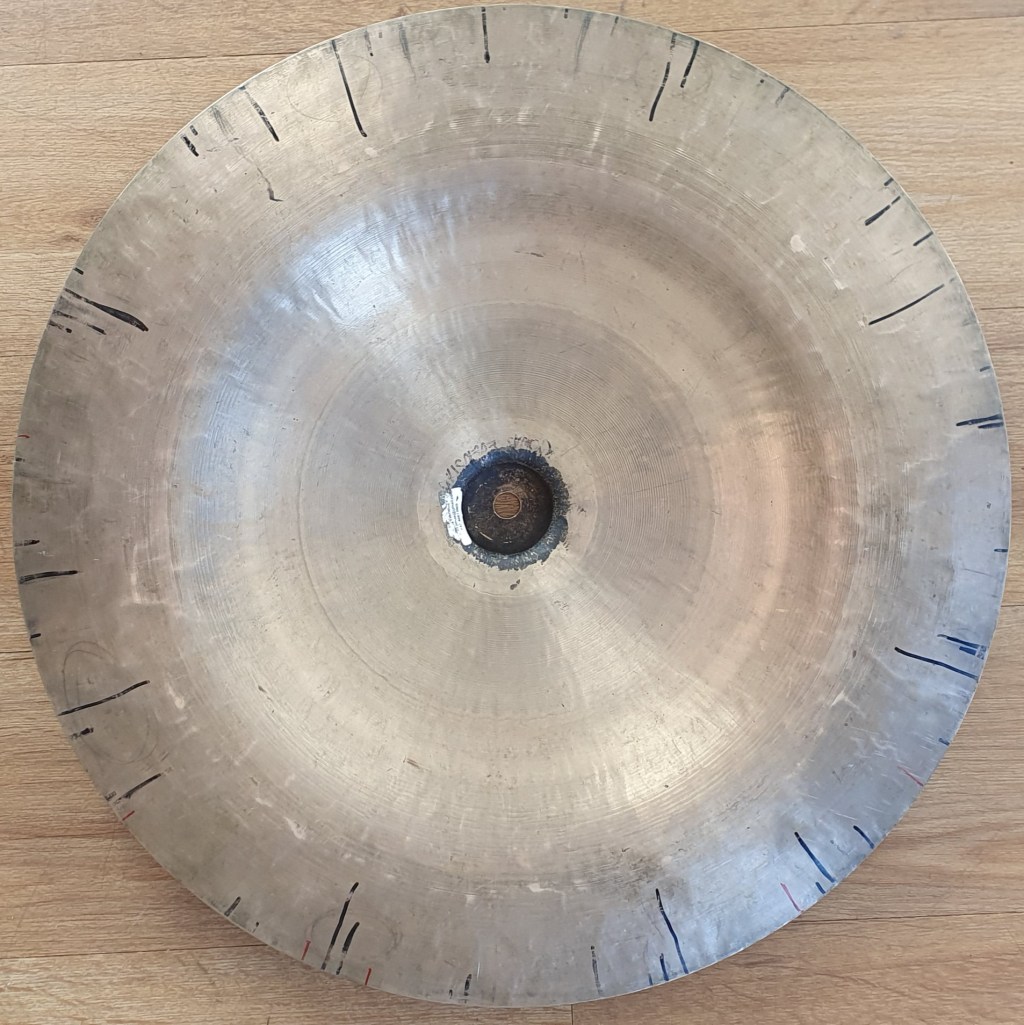
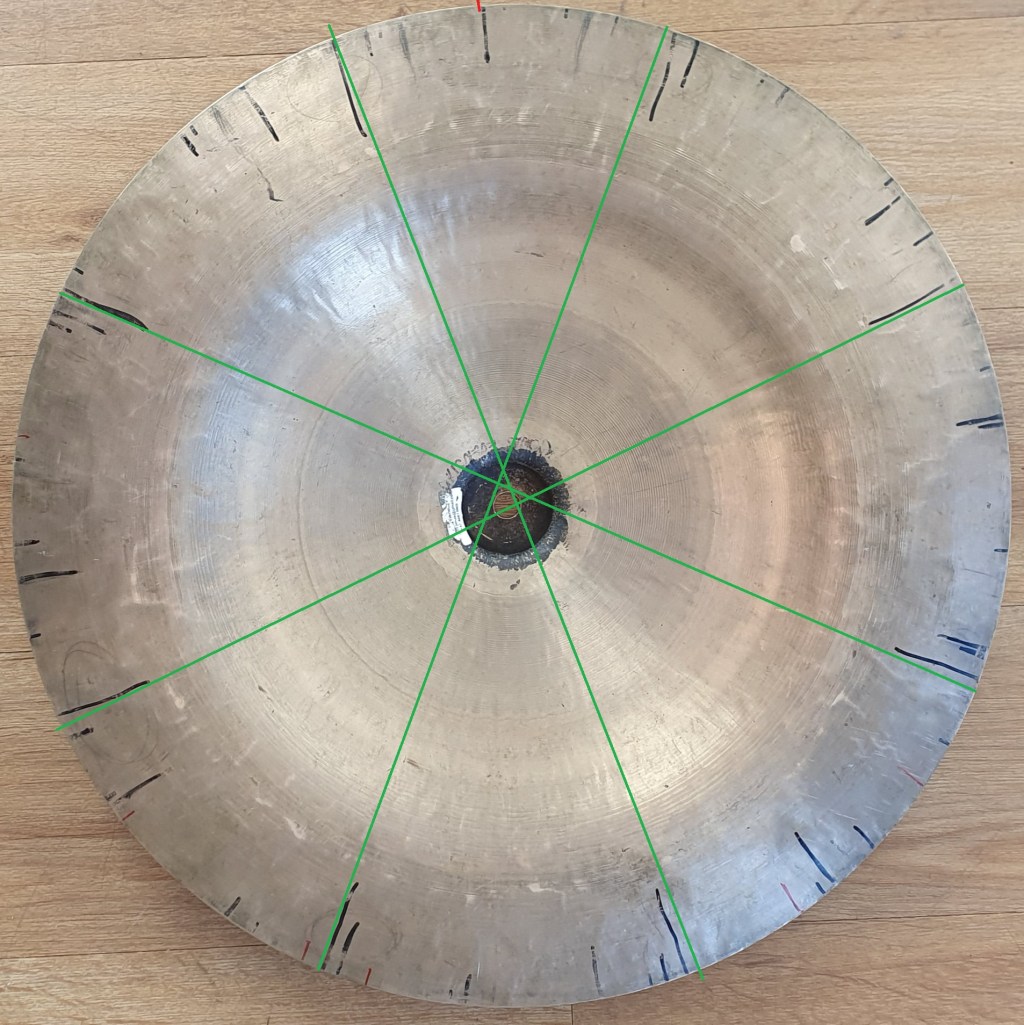

These lines map the waves zero-points. When the cymbal is vibrating in one of these modes, are waves = 0 at these lines. Then by dampening on the spesific lines while bowing in between them, I am able to make a clear and consistent pitch. This is by dampening all other modes that don’t have these lines as zero-points.
I use the same system for the wind-gong. Since the gong hangs instead of balancing in the middle, like the way the cymbal does, the patterns are not symmetrically spaced around the instrument, I have therefore only been able to partially map some modes.

While I am able to make clear frequencies with this method, they often come with a reverb or background chord that are based on the instruments internal harmonic structure (other modes of vibration). These are part in making the unique soundscape possible, and by combining the gong and the cymbal, I am able to make rich harmonic structures that harmonise in different structures than the natural overtone series.
the Bow Paradox:
Durch die Arbeit mit deutliche Frequensen, gespielt auf undefiniert-Tonhöhe Idiophonen. Habe ich entdeckt, das die naturliche Übertonereihe nicht eingebaut im Instrument ist. Dennoch finde ich immer diese Tonreihe scheinlich in digitalen Spektralanalysen. Am Anfang war es nicht klar für mich, warum das war so. Aber ich habe entdeckt, dass Kontakt zwischen Bögen und Idiophonen gibt die Naturliche Übertonereihe. Man kann fragen: ‘warum?’.
Mein Teori ist, dass verschiedene Haare des Bogens vibrieren in Frequens mit dem Ton. Weil die Haare sind Saite, produsieren sie die ganze Übertonreihe in verschidenen Phasen. Wann die Saite, in ein spezifisch Übertone trifft, wird dieselbe Vibration in der Luft produsiert geworden. Die Frequens ist auch produsiert in der Gong. Weil diese Produktion in viele verschiedene Haare gleichzeitig passiert ist, gibt es die ganze Naturliche Übertonreihe.
Diese Ereigniss macht es möglich, für spezifiche modes of vibration zu singen. Die modes of vibration wie singen werden, sind die modes of vibration die zimelich nah in Tonhohe ist. Deswegen, nach ein moment, wird der Gong in eine variert Stimmung singen. Eine Stimmung die ganz/ziemelich nah der Naturliche Übertonereiehe klingen.
Ich habe diese Entdeckung ‘The Bow Paradox’ gennant. Das ist weil ‘the bow’ macht es möglich, für die Gong mit naturliche Übertonen zu spielen – etwas die eigentlich nicht möglich zu tun ist.
The video shows how the natural overtoneseries appear in contact between bow and idiophone.
 JonasEvenstad